- A general AI model has never seen your documents, so when asked about your business it fills the gap with something plausible. That is where wrong answers come from.
- RAG (retrieval-augmented generation) searches your own documents first, hands the model only the relevant passages, and lets it answer from those, with sources.
- It is the right tool for facts that change and must be checkable. Fine-tuning is for tone and format, not facts. Most businesses need RAG first.
If you have tested an AI chatbot or agent on your own business you have probably seen it happen. You ask about your returns policy and get a confident, well-written answer that is simply wrong. It did not lie on purpose. It made a reasonable-sounding guess, because that is what it was built to do. This is the single biggest reason businesses hesitate to put AI in front of customers or staff, and it is the problem retrieval-augmented generation, RAG, was built to solve.
The problem: AI making things up
Large language models are trained on huge amounts of public text: the internet, books, code. That gives them a broad sense of language and reasoning, and no knowledge of your company. They have never seen your price list, your staff handbook or last week’s stock count, because none of it was in the training data.
So when you ask a general model a specific question about your business it does the only thing it knows how to do: predict the most likely next words. If your business is not in the data, the model does not say “I don’t know”. It fills the gap with something plausible. People call this hallucination. It is not a bug you can scold the model out of; it is a direct result of how these models produce text.
For a business that is a real liability. An agent that invents a delivery time, misquotes a warranty term or makes up a compliance detail causes real damage. If an agent is going to do actual work, answering customers, briefing staff, looking up accounts, it has to be right, not just fluent. RAG fixes this by changing where the AI gets its facts.
How RAG works, in three steps
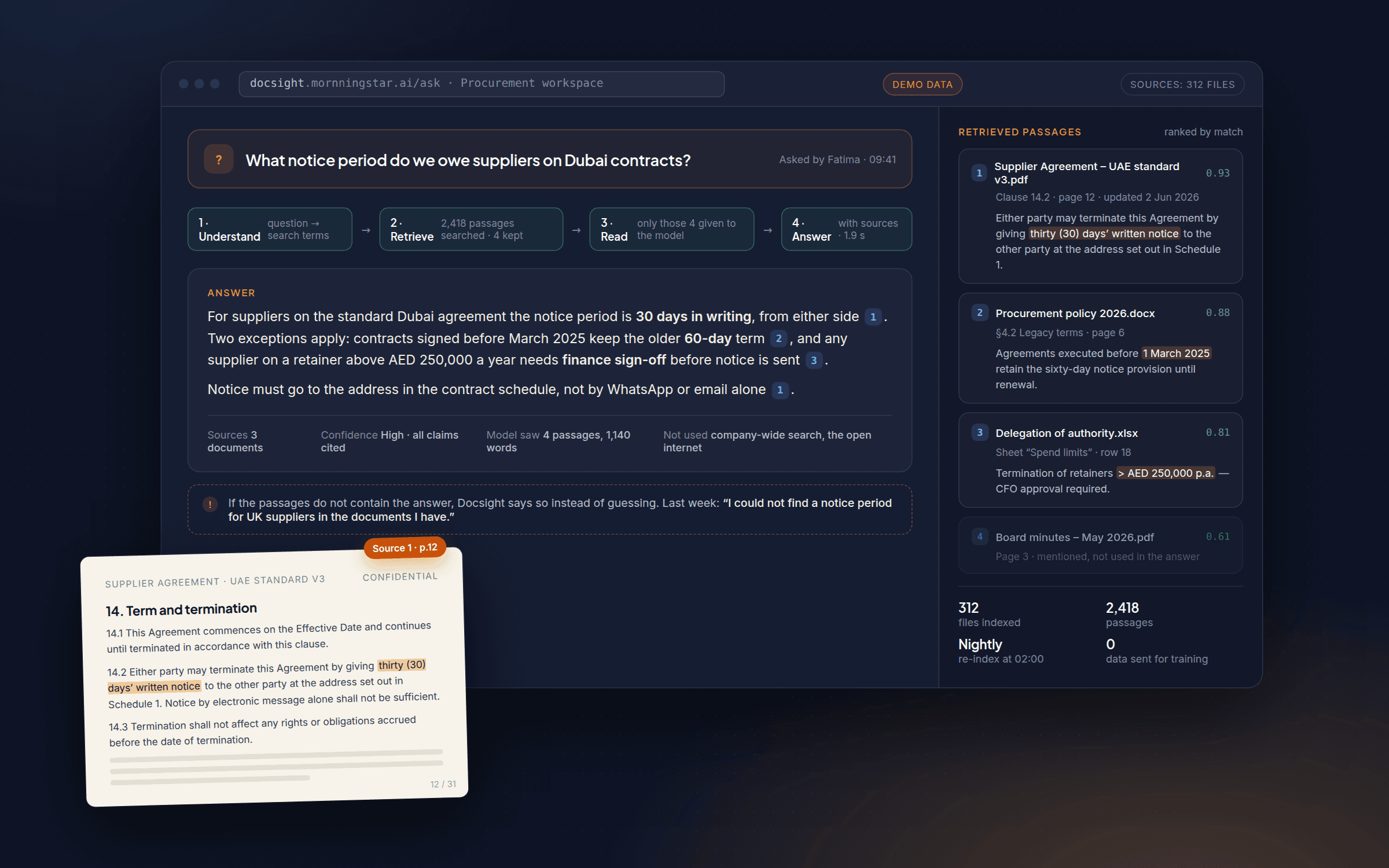
The name is an honest description. The system retrieves the relevant information, augments the question with it, and only then lets the model generate an answer. The model is handed the source material for this specific question, every time, instead of relying on what it half-remembers from training.
1. Retrieve
When a question comes in (“what is our refund policy on opened items?”) the system does not send it straight to the model. First it searches your own material: policy pages, product manuals, past support tickets, the internal wiki, a database, whatever has been connected. The search matches the meaning of the question, not just the exact words, so it finds the right passage even if the customer phrased it differently. The result is a small set of relevant passages, three or four paragraphs from the policy document that actually discuss opened items. Not your whole knowledge base. Just the slice that matters.
2. Augment
The system then builds a prompt that contains both the question and the retrieved passages. In plain terms: “Using the following policy text, answer the customer’s question.” Mechanically simple, but it is the hinge the whole approach turns on. Your actual facts are put directly in front of the model instead of leaving it to recall them.
3. Generate
Only now does the model write the answer, grounded in the text it was just given. A well-built system also tells the model to stick to that material and to say so when the answer is not in it, instead of reaching for a guess. The reply reads like natural language, but every fact in it can be traced to a passage in your documents.
RAG versus fine-tuning
Fine-tuning is the other well-known way to customise a model, and the two get lumped together although they solve different problems.
Fine-tuning retrains the model itself on examples of your data. It is useful for teaching a style: your brand’s tone of voice, a particular output format. It is poor at keeping facts current and checkable. Once tuned, updating the model with new information means retraining, which is slow and costly, and you still cannot easily point to which example produced a given answer.
RAG is built for facts that change and need to be traceable. Update a policy document or a price list and the very next question gets the new answer, with no retraining and often no delay. And you can show the source passage behind every answer, which matters the moment someone needs to check the agent’s work.
They are not rivals. Teams often use both: fine-tuning for tone and structure, RAG to keep the facts anchored to real data. But for most businesses asking how to make an agent answer accurately about their own operations, RAG does the heavy lifting, because the core problem is almost always facts, not style.
What this means for trust
An agent built with RAG answers from your current documents, not a frozen snapshot of the internet. That is the difference between an agent you can cautiously put in front of customers and one you have to supervise.
It is not automatically foolproof. A RAG system is only as accurate as the material it retrieves from, so clean, organised, up-to-date sources matter as much as the model. Deciding which sources feed in, keeping them current and connecting them cleanly is most of the real work, and it is what our data and integrations service exists to do. But RAG turns “the AI is guessing” into “the AI is reading our documents and summarising them”, which is a fundamentally more checkable kind of accuracy.
Questions
Does RAG mean the AI is trained on my data?
Can it work with data that changes daily, such as stock or prices?
Is RAG only for chatbots?
Is my data sent to the AI company to train its models?

Leads every 90-day programme personally. Writes these notes from the projects that shipped and the ones that did not, so you can skip the second kind.