- Decide whether you need outside help before you compare who to hire; they are different questions and blurring them means hiring a capable partner to build the wrong thing.
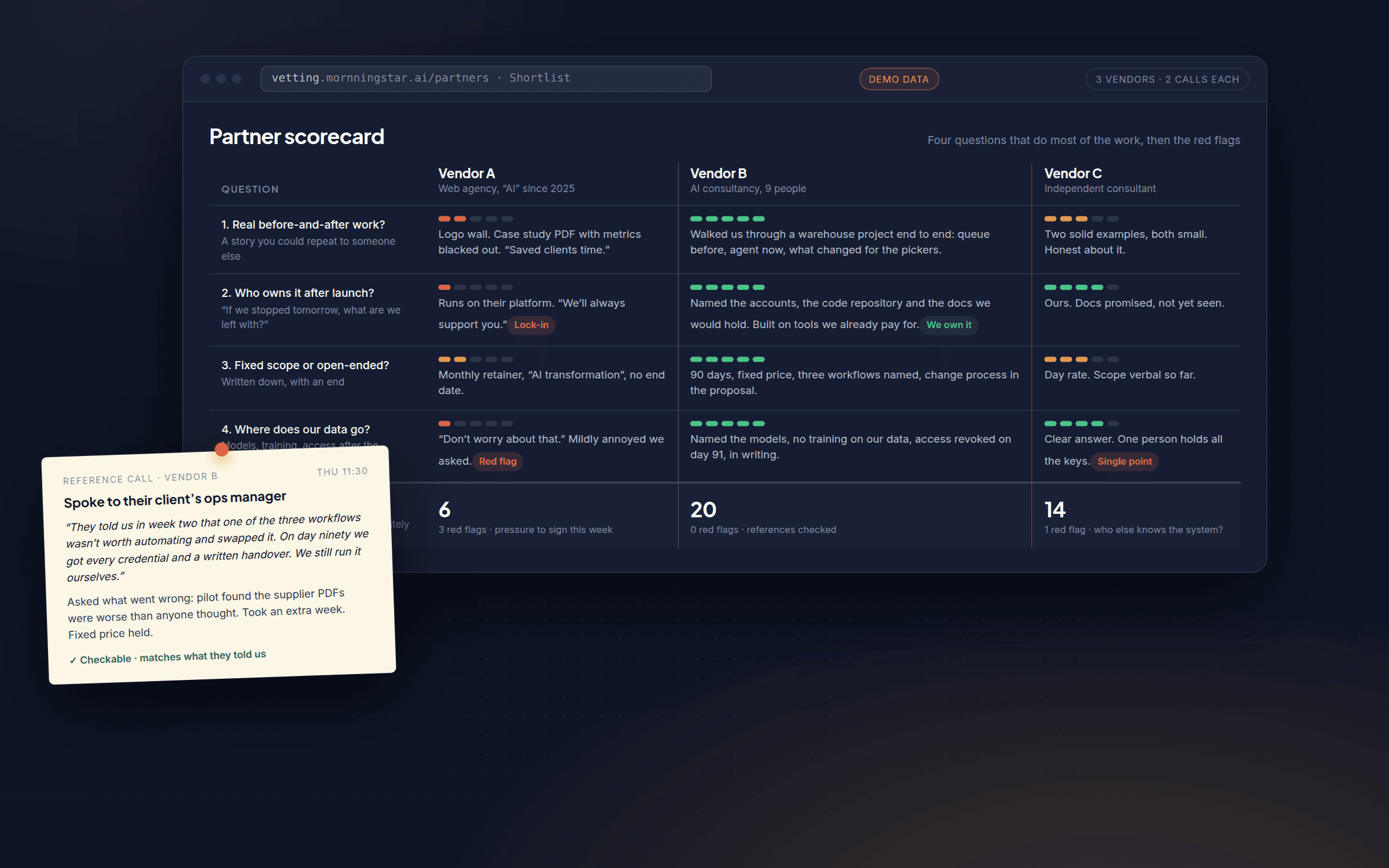
- Four questions do most of the work: can they show real before-and-after work, who owns the system after launch, is the scope fixed, and where does your data go.
- Specific guarantees before any discovery, pressure to sign, nobody who can explain the technical side plainly, and demos with no maintenance plan are the red flags.
The AI automation market has a lot of new signage on old doors. Web development shops, marketing agencies and freelance consultants have relabelled themselves as AI partners in the last two years. Some are genuinely good at it. Others are learning at your expense. There is no licence or certification that tells the two apart, so the checking falls to you. It is not a long process. Below is the checklist we would want a client to run on us, and on anyone else they are considering.
First, have you answered the earlier question?
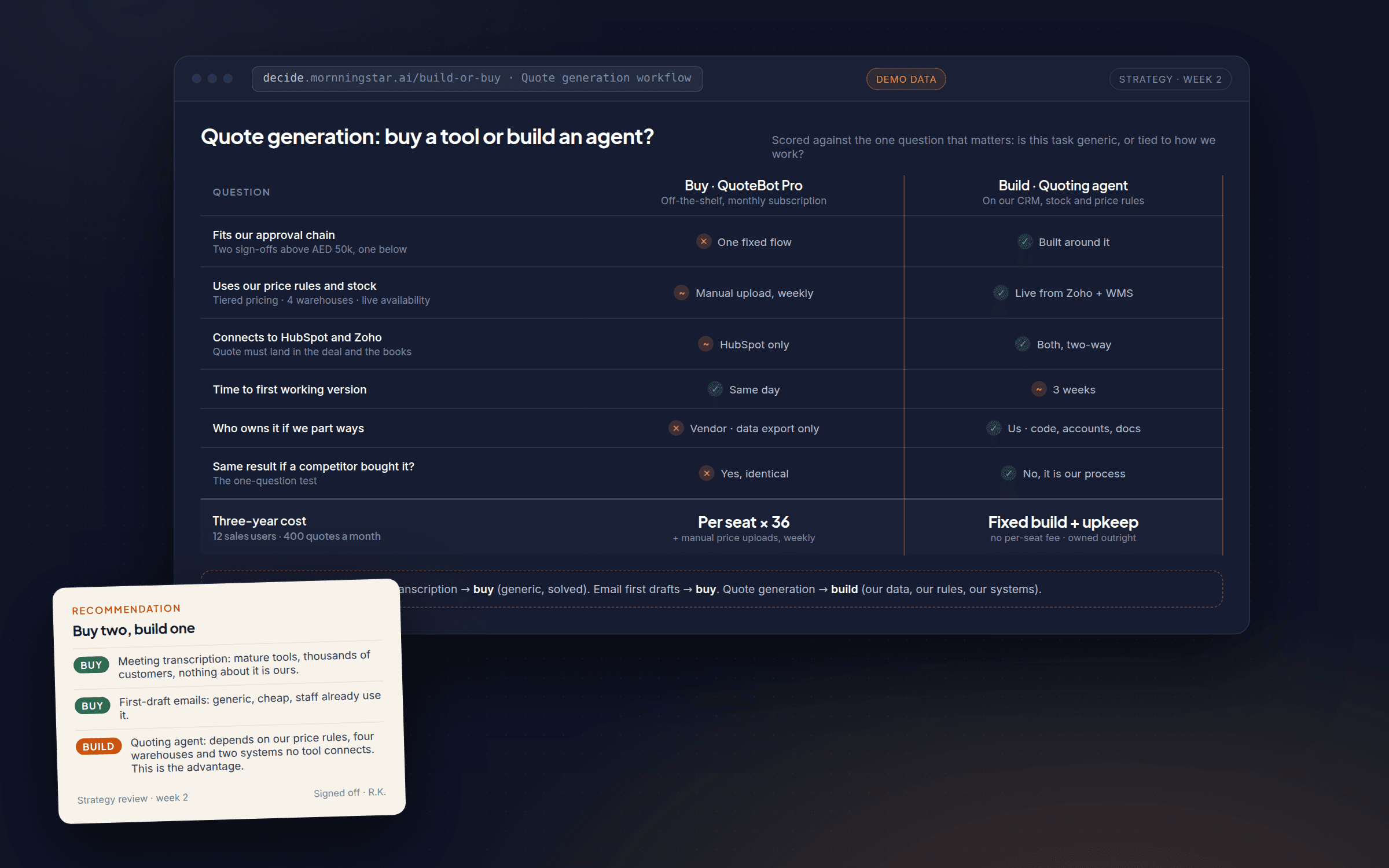
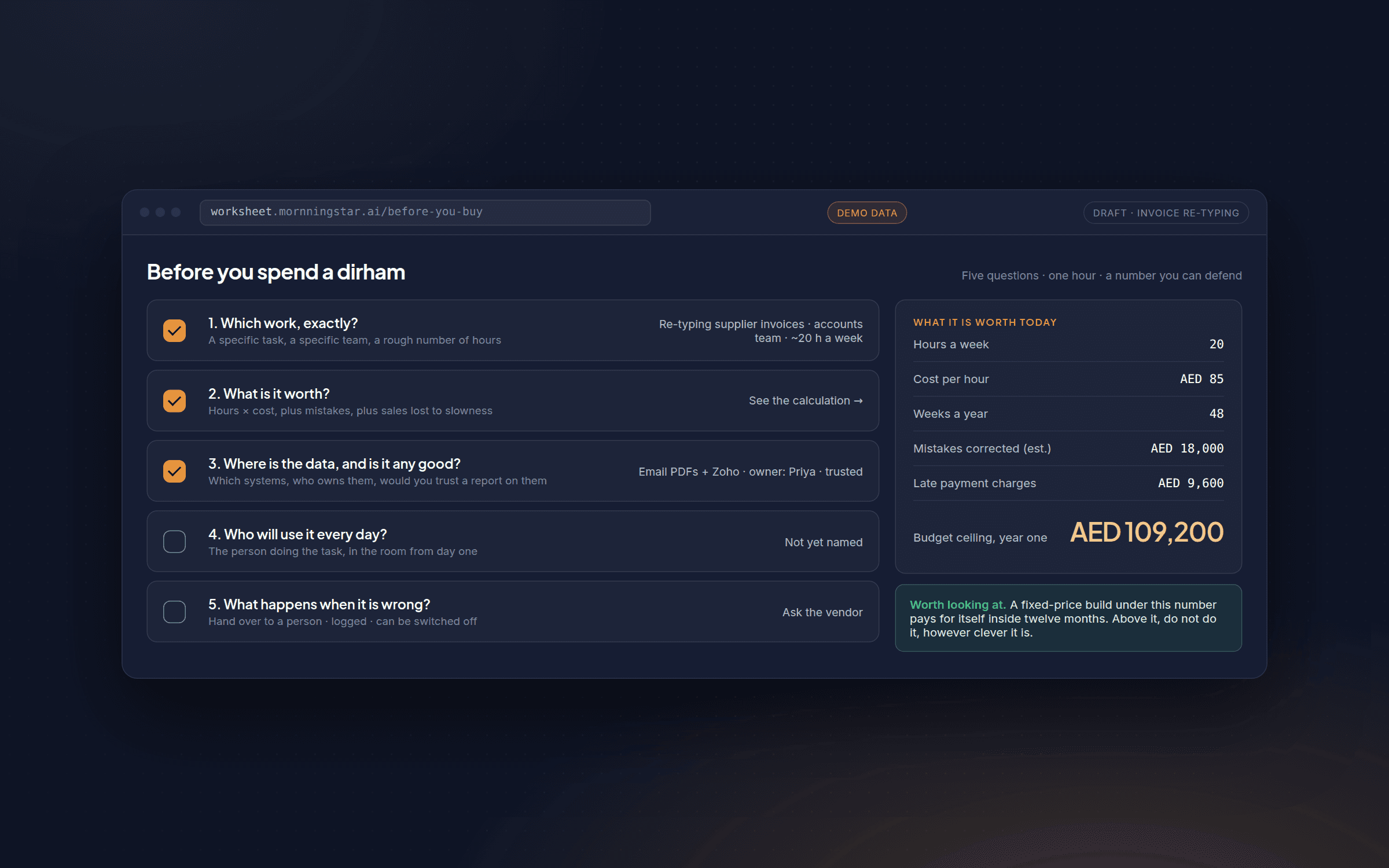
Before you evaluate any specific company, settle the question underneath it: should you be buying outside help at all, and for what? If you have not worked through that yet, read five questions to answer before you spend a dirham on AI first. That note is about whether to bring in help: what problem you are solving, whether it is an AI problem at all, and what “done” looks like.
This note starts after that decision. You know you want help; now you are choosing who. The two questions blur easily but they are separate. One is strategy, the other is procurement. Skip the first and you will end up choosing a very capable partner to build the wrong thing.
Four questions that do most of the work
Ask them directly, and pay attention not just to the answer but to how comfortable the person is giving it.
1. Can they show real before-and-after work?
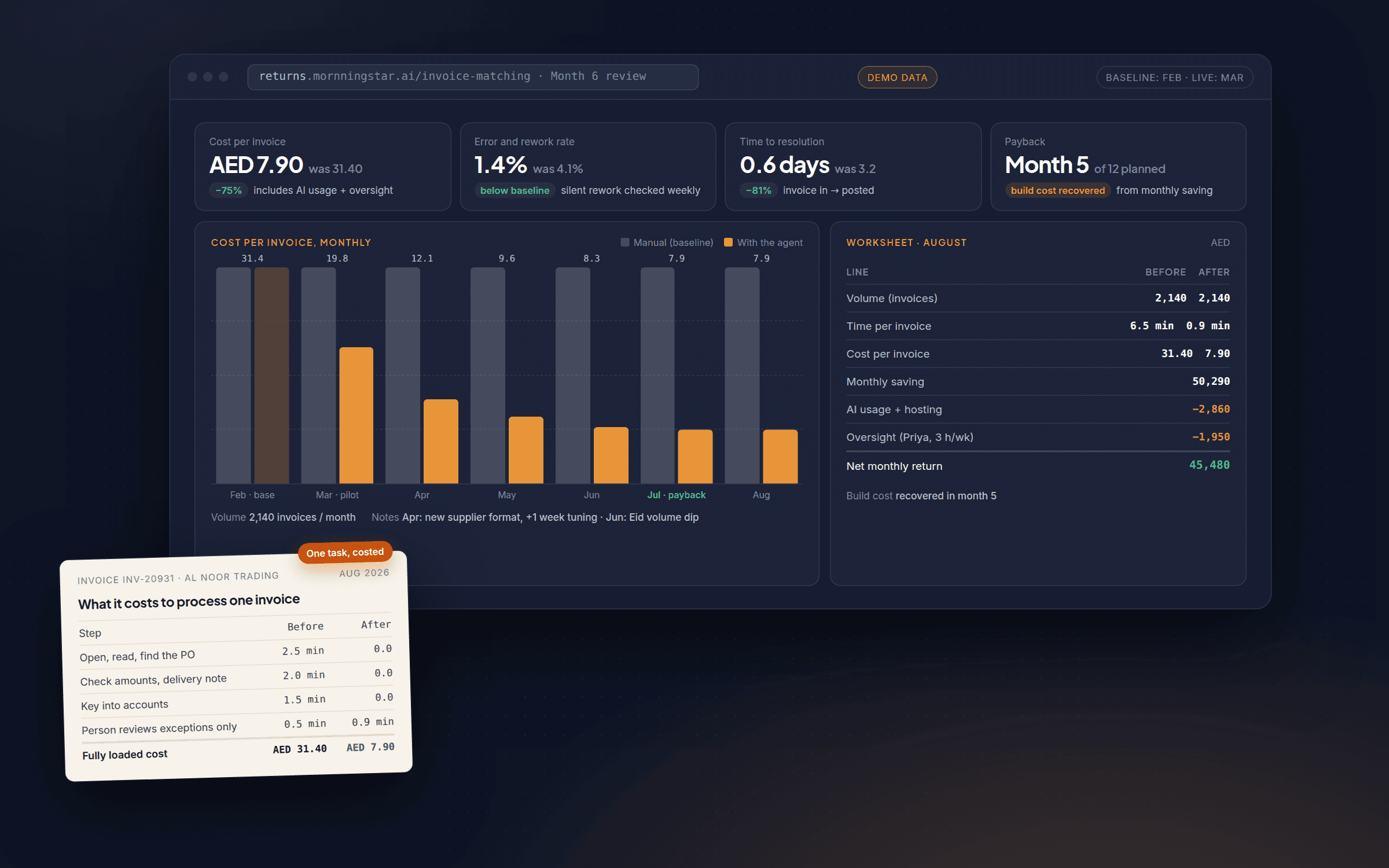
Ask for specific examples: what a client’s process looked like before, what it looks like now, and what changed. Not a logo wall. Not a case-study PDF with the numbers blacked out. An explanation you could repeat to someone else. If a company can only speak in generalities (“we help businesses save time and increase efficiency”) it either does not have enough real project history yet or is not willing to be specific about what it did.
You do not need a client in your exact industry. You do need to follow the story end to end: here is what was slow or manual, here is what we built, here is what changed for the people using it. Our own case studies are written to that standard, and it is a fair bar to hold anyone to.
2. Who owns the system after launch?
This is the question people forget, and the one that causes the most pain later. Some agencies build automations that only run inside their own platform, so if you ever want to leave you rebuild from zero. Others build on tools and accounts you control, hand over the documentation and credentials, and can walk away cleanly if that is what you want.
Ask it plainly: “If we stopped working together the day after launch, what would we be left with?” A good answer names the accounts, code repositories and platforms you would hold. “Don’t worry, we’ll always support you” is a sales line, not an answer. You want to own your data, your workflows and ideally the core logic, whoever built it and whoever maintains it.
3. Fixed scope or open-ended?
AI projects have a reputation for scope creep, and some of it is earned. Before you sign, find out what is actually fixed. Is there a defined start and end, or does “AI transformation” become the reason the engagement never quite finishes? Is the price tied to a describable outcome, or is it a retainer with no exit?
Neither model is automatically wrong. A single automation with a clear job suits a fixed-scope project. Deeper work benefits from a structured, time-boxed programme, something like a 90-day launch rather than an indefinite engagement. What you want to avoid is ambiguity: a proposal that does not say what is in scope, what is out, and what happens if requirements change midway.
4. Where does your data go?
Any partner worth hiring can answer, without hesitation, where your data goes, who can see it and how long it is kept. It matters more than it used to, because “AI agent” often means a system with standing access to your inbox, CRM, customer records or finances, not a one-off script.
Ask specifically: which third-party AI models or platforms will touch our data? Is any of it used to train a public model, or is it kept to our systems? What happens to access and data when the contract ends? If the answers are vague, or the vendor seems mildly annoyed you asked, treat that as information. A serious partner has a clear, rehearsed answer because clients ask often enough that it should be routine.
Red flags
- Guarantees that sound too specific. Nobody can promise a fixed revenue increase or a fixed number of hours saved before looking at your workflows. Confident numbers before any discovery are a sales tactic, not a forecast.
- Pressure to sign quickly. A legitimate partner is not worried about you taking a week to think, ask a colleague or compare a second option. Urgency exists to stop you doing exactly that.
- Nobody can explain the technical side plainly. You do not need to understand the architecture, but someone should be able to say what tools are involved and what data moves where without retreating into jargon.
- All demo, no infrastructure. Impressive demos, then silence on maintenance, monitoring, and what happens when the underlying AI model changes, which it will. A demo is not a system.
- One person is the entire company. Independent consultants can be excellent. Be clear about what happens if they fall ill, get busy or move on. Ask who else knows how the system works.
None of these alone is disqualifying. A confident guarantee might be enthusiasm; a quick timeline might be real availability. Two or three stacking up on the same vendor is worth pausing over.
The checklist
Before you sign anything you should be able to say yes to each of these.
- They have shown a specific, verifiable before-and-after: a real explanation of what changed, not just a number.
- You know exactly what you would keep (data, access, code) if the relationship ended tomorrow.
- Scope, timeline and pricing are written down, not spoken.
- You have a clear, specific answer on where your data goes and who can access it.
- Someone on their team can explain the technical approach in plain language.
- You have not felt rushed.
- More than one person understands how the system works.
- References are checkable, not just claimed.
Tick all eight and you have done more diligence than most buyers in this market. If you want to see how we answer these questions ourselves, the case studies and the about page are the place to start, and thirty minutes on a call will cover the rest.
Questions
Should we run a paid pilot before committing?
Does the partner need experience in our industry?
How many partners should we compare?

Leads every 90-day programme personally. Writes these notes from the projects that shipped and the ones that did not, so you can skip the second kind.